Seed3D 1.0: A High-Fidelity, Simulation-Ready 3D Foundation Model for Embodied AI
Seed3D 1.0 from ByteDance delivers a new class of 3D foundation model focused on three pillars: high‑fidelity asset generation, native compatibility with physics engines, and scalable decomposed‑to‑composed scene generation. Its standout capability is to transform a single input image into a simulation‑ready 3D asset that can be directly imported into industry simulators like Isaac Sim—with collisions, material semantics, and scale estimation ready out of the box.
Official page: https://seed.bytedance.com/en/seed3d
Technical Report (PDF): https://lf3-static.bytednsdoc.com/obj/eden-cn/lapzild-tss/ljhwZthlaukjlkulzlp/seed3d.pdf
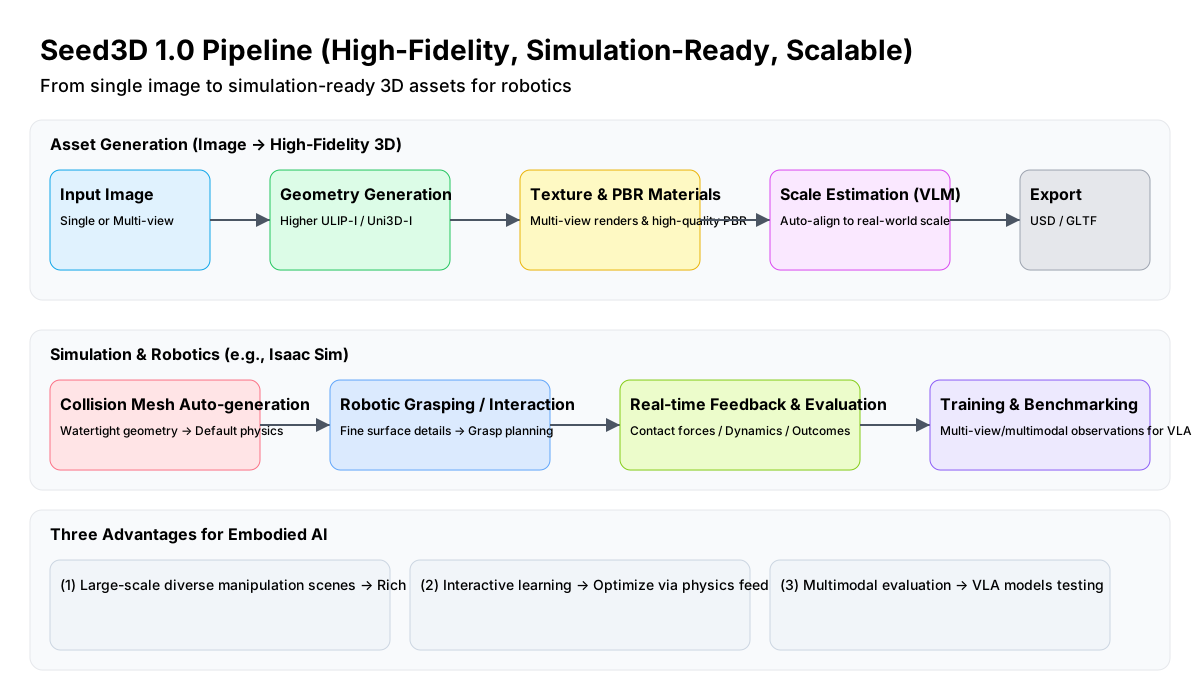
Why It Matters: Simulation‑Ready World Modeling for Embodied AI
Unlike general 3D generation systems that optimize for visual realism alone, Seed3D prioritizes simulation usability:
- Watertight manifold geometry ensures reliable collision mesh generation and physics application.
- Default physics properties (e.g., friction) are pre‑applied for immediate interaction.
- Scale estimation via VLM enables assets to match real‑world physical dimensions.
This design unlocks three core advantages for embodied AI:
- Dataset generation at scale through diverse manipulation scenes.
- Interactive learning with physics feedback (contact forces, object dynamics, task outcomes).
- Multi‑view, multimodal observation enabling systematic evaluation for VLA models.
Asset Generation: Dual Focus on Geometry and Materials
From a single image, Seed3D generates accurate 3D geometry and coherent PBR materials, optimized across fidelity and physical consistency.
- Geometry quality validated by metrics such as ULIP‑I and Uni3D‑I, showing strong alignment to the input image.
- Material realism with multi‑view renders and high‑quality PBR parameters (albedo, roughness, normal maps, reflectance).
- Scale estimation driven by VLM to align asset dimensions with real‑world physics.
One‑Step Simulation: Import, Collide, Manipulate, Feedback
Seed3D assets are designed for plug‑and‑play use in simulators:
- Automatic collision mesh generation and default physics assignments.
- Ready for robotic manipulation involving grasping and multi‑object interactions.
- Preserves fine surface features (details in toys, consumer devices) crucial for robust grasp planning.
Scene Generation: From Decomposition to Composition
Seed3D goes beyond single‑object synthesis to parse scenes from an image and rebuild them via a decomposed‑to‑composed pipeline:

- Use a VLM to extract object instances, classes, and counts.
- Infer spatial layout (position, size, relative placement) and material semantics.
- Generate per‑object geometry and materials.
- Compose and place objects into complete scenes, across indoor, outdoor, and multi‑scale environments.
Typical Developer Workflow
- Input: a single image (or multi‑view images).
- Generate: 3D geometry + multi‑view renders + PBR materials.
- Estimate: scale via VLM to match real‑world dimensions.
- Export: standard formats such as USD / GLTF.
- Simulate: let Isaac Sim auto‑generate collisions and assign default physics.
- Operate: run robotics experiments—grasping, multi‑object interaction—and collect contact/dynamics feedback.
Use Cases and Potential Applications
- Robotic manipulation: detailed geometry and consistent materials aid grasp planning and execution.
- Interactive learning: embodied agents improve via physics feedback loops in simulation.
- Data generation and benchmarking: multi‑modal, multi‑view scene data for VLA evaluation.
- Digital twins and industrial simulation: high‑fidelity assets with scalable scene composition.
Comparison with Other Approaches (User Studies)
Seed3D demonstrates strong performance across six key dimensions—clarity, faithfulness, geometric quality, perspective/structure, material/texture, and fine details—outperforming multiple 3D generation baselines. This suggests superior joint quality of geometry alignment and material realism.
Resources and Report
- Official page (English): https://seed.bytedance.com/en/seed3d
- Technical Report (PDF, downloadable): https://lf3-static.bytednsdoc.com/obj/eden-cn/lapzild-tss/ljhwZthlaukjlkulzlp/seed3d.pdf
If you are exploring embodied AI, robotic manipulation, or large‑scale simulation data generation, we recommend reading the full technical report and importing Seed3D assets into your simulator to test physics and interactions. The model’s combination of high‑fidelity + simulation‑ready + scalable scene composition shortens the path from image to usable asset—accelerating development across research and industry.